
© Photography by Prof Lorraine Whitmarsh MBE
Words by Dr Lois Pennington
With five UK airports seeking to expand, and the government broadly backing them, I joined Geographical Magazine’s new podcast “On the Ground” to explore what the Bristol Airport inquiry, decided three years ago, still has to tell us.
We are in an unusually busy period for UK airport expansion. Around five major airports are currently seeking to grow their capacity, and the government has signalled its support. To put it in context, if all these expansions went ahead, we would see passenger numbers more than 70% higher in 2050 than we saw in 2018.
The underlying issue is that aviation is one of the hardest sectors to decarbonise, and yet airport expansion has found renewed political space in recent years. In a cost-of-living crisis, the argument that expansion brings economic benefits is an appealing one. Whether those benefits actually materialise is a separate question, one that Parliament’s own commissioned review has cast serious doubt on. A vocal minority opposing climate action has also been gaining political traction, creating room for these arguments at a high level.
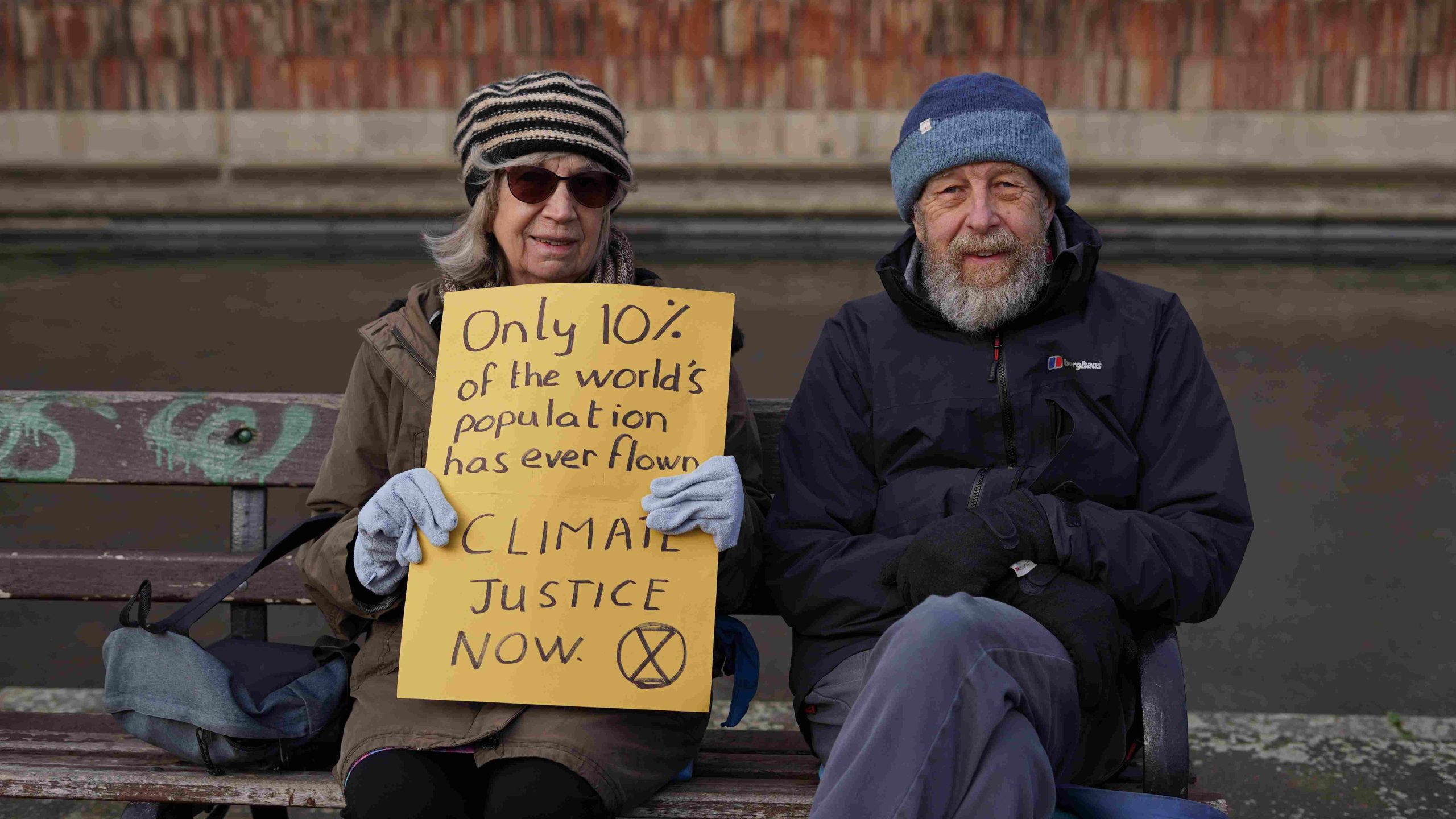
Aviation has, in many ways, long been treated as an untouchable sector. Too complicated to easily do the carbon accounting, too emotive to talk about constraining, and too politically difficult to ask questions about who is actually flying. The consequence of this is a carbon footprint that, by any fair measure, has been allowed to grow and expected to continue to grow well beyond its proportionate share. I explore this unfairness further with a colleague in a recent comment piece for Climate Uncensored.
This is the backdrop against which Geographical Magazine’s new podcast “On the Ground” revisits the Bristol Airport expansion inquiry, a ten-week planning battle concluded in 2022, to revisit what we can learn from it now. Here I reflect on some of the points we discussed in the programme.
Why look back at Bristol?
In 2018, Bristol Airport Limited applied to expand its capacity from 10 to 12 million passengers a year. North Somerset Council refused the application in 2020, citing climate and environmental concerns. Bristol Airport appealed, triggering a ten-week public planning inquiry. In February 2022, the Planning Inspectorate overturned the council’s decision and approved the expansion. That ruling was subsequently upheld by the High Court in January 2023, and by the Court of Appeal in May 2023. What had started as a local planning dispute had escalated into a national argument about who is responsible for keeping aviation within the UK’s carbon budgets. The arguments made along the way have not disappeared.
As my University of Manchester colleagues and I submitted to the Environmental Audit Committee’s call, the current government support for aviation expansion is simply incompatible with the UK’s legally binding climate commitments.
Whilst preparing to go on the podcast, I noticed three arguments reflected or reinforced in the inquiry that are being recycled, nearly verbatim, in current cases.
The first is that climate targets can be treated as secondary to perceived economic benefits, even when those climate targets are legally binding. This logic rests on the economic case for airport expansion, associated increases in jobs, growth and tourism, and is increasingly being shown to lack evidence. The Environmental Audit Committee, a cross-party group of MPs that examines whether government policy is compatible with environmental goals, reported in October 2025 that it could find no credible government plan for how expansion could be made compatible with our climate targets, and no evidence that the promised economic benefits would materialise. A finding that is striking, given that the inquiry was open to submissions from across the aviation industry.
The second argument we have seen raised, both in 2022 and again in recent expansion discussions, is the displacement argument. The idea that if Bristol didn’t provide the flights, passengers would simply travel to London or Cardiff instead and the emissions would happen regardless. This approach treats demand for flying as though it were a fixed quantity, but the reality is demand is shaped by policy, cost and availability. It responds to what is on offer, and building more capacity creates the conditions for more demand.
The third argument, upon which Bristol Airport’s lawyers’ argument hinged, is that local planning authorities cannot or should not enforce climate limits. Bristol Airport’s legal team repeatedly maintained that the duty to ensure carbon budgets are met lies with the Secretary of State, not local planners, and that Bristol’s contribution to emissions was “a fraction of a percent”. Following that logic, if every airport can make that argument, the cumulative impact of all these decisions is never examined. The government’s own climate advisers have stated that overall aviation emissions cannot increase in the near future, and yet there is no national mechanism to ensure they don’t.
The technology picture isn’t improving
This structural gap of who can enforce these climate limits would matter less if the technologies being relied upon to close the emissions gap were on track.
The government’s case for expansion still rests on the assumption that low-carbon fuels (known as Sustainable Aviation Fuel or SAF), hydrogen aircraft or even direct carbon capture from the air will allow us to keep flying, while emitting less. Having examined what these technologies have so far delivered, the picture is not encouraging.
The UK is already expected to miss its first target for SAF uptake, and in fact the industry has a 20-year history of missing its SAF production targets. Low-carbon fuel projects are being delayed or cancelled globally. Hydrogen aircraft development is stalling. Direct carbon capture remains nowhere near the scale required, and raises serious questions about whether using such an energy-intensive process to offset aviation emissions is a sensible use of our limited clean energy systems.
As my University of Manchester colleagues and I submitted to the Environmental Audit Committee’s call, the current government support for aviation expansion is simply incompatible with the UK’s legally binding climate commitments.
The government’s response to all this has been to rule out demand management, or flying less, as politically off the table.
The Climate Change Committee, the independent body that advises the UK government on emissions targets, has been clear: aviation can only grow if low-carbon fuels and aircraft efficiency significantly outperform current expectations. Without that, emissions will rise with demand. What this means practically is that in any coherent system, expanding one airport would require limiting or closing another. As it stands, there is no national mechanism to make those trade-offs, and instead they are being deferred, expansions signed off on the assumption we will find a way to reduce emissions later. The risk is that we don’t know we have failed until we have already exceeded our carbon budgets.
The government responded to the EAC report in January 2026, committing to review airport planning policy and consult on changes by summer but making no commitment to pause expansion decisions in the meantime, and no acknowledgement that current plans are incompatible with our climate targets. It is not a surprising response, and it does not address the issues raised by the committee or the evidence submitted to it.
Listen to the Full Episode
I was recently a guest on “On the Ground”, a new podcast by Geographical Magazine exploring significant local decisions and their wider implications. The first episode tells the full story of the Bristol Airport inquiry, including the campaigners who took on international corporate heavyweights, the legal arguments that wound up in the highest courts, and an unexpected voice that captures quite how the accountability gap feels in practice.
Who is counting aviation emissions, and who is accountable when no-one is? It’s a question our planning system still isn’t designed to answer. If the past few years are anything to go by, the courts may end up being asked to answer it instead.
Follow us on Bluesky and LinkedIn and subscribe to our newsletter for future updates from the CAST team.