
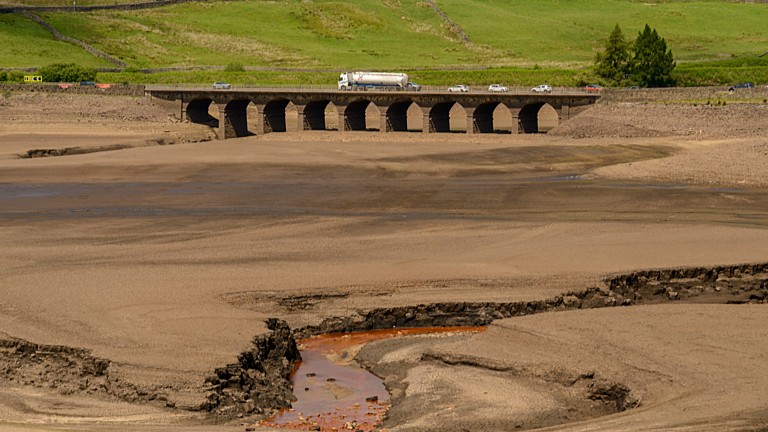
© Credit: Alastair Johnstone-Hack / Climate Visuals
Words by Dr Chris Pollard, Senior Researcher at Climate Outreach
Today marks the release of the Climate Change Committee’s (CCC) “A Well-Adapted UK” report. It proposes targets for government to adopt to ensure we live in a well-adapted UK. But how well does it speak to the concerns of British people?
This groundbreaking step into adaptation from the CCC outlines eight climate risk areas (heat; flooding; water availability; risks to nature; on farming; food security; availability of insurance; and interlinked or cascading risks) for the UK to address, and recommendations about how they should do it.
As a researcher specialising in public engagement on climate, it’s great to see acknowledgement up front in the report that people in the UK are really concerned about how unprepared the UK is for climate change,and that they want to see action. We often advise climate communicators to talk about how climate change will impact the lives of their audience. Reducing the psychological distance of climate change by talking about local hazards and the impacts on ourselves and our children, is effective in achieving positive engagement on climate. Much of this work, though, has been focussed on encouraging support for participation in mitigation behaviours, in efforts to reduce the impacts that we face through achieving a reduction in greenhouse gas emissions. As a result people generally know more about mitigation activities than adaptation activities.
Should we be surprised then that people feel that the UK is underprepared for the impacts of climate change? Of course not, climate communicators literally ask people to think about it all the time! It’s just now that we have this whole other set of actions that the CCC have outlined, and a recommendation from them for governments “to lead a public dialogue about the level of resilience people expect and their willingness to pay for it”. This is really welcome, and I look forward to the government response to the report.
And it’s this message which is really important for me, that adaptation and mitigation actions aren’t a zero sum game. We need to, and are able to, do both at the same time.
So how do we now talk about what we need to do to protect ourselves, as well as what we need to do to minimise the impacts? Ask people about adaptation and the conversation often includes talk about wind farms and footprint reduction, actions which we in our plump climate bubble categorise as mitigation activities. If we really want to focus on adaptation in the UK, maybe we should be clear about the distinction between the two? Well, yes and no. Our work at Climate Outreach recommends that we need to be talking about both activities together, that tackling climate change means both reducing pollution and adapting to its impacts, and that we need to keep on doing both. In cases where mitigation and adaptation are pitted against each other (in our own heads or by others), we should be clear that there’s strong public support for tackling climate change by both reducing its impact and adapting to it.
The Well-Adapted UK report acknowledges the intertwined nature of mitigation and adaptation, for example when talking about dealing with increased heat risk. The report notes that alongside interventions such as natural shading which passively cool buildings, we’ll also need active cooling such as more air conditioning. Active cooling takes energy, but as the report says, “increased levels of active cooling can be managed alongside the transition to a reliable low carbon electricity system”.
And it’s this message which is really important for me, that adaptation and mitigation actions aren’t a zero sum game. We need to, and are able to, do both at the same time. So we have another communication challenge (on our long list of climate communication challenges): to make clear the links between our actions that create the pollution and our actions which respond to its consequences, and telling those stories of how both are happening in concert.
At Climate Outreach we hear across the country a high level of concern about our preparedness for the impacts of climate change, and we see the strong desire for action. This important report is very welcome in bringing the focus onto climate adaptation for those in government in the UK. But when we’re talking about adaptation it’s vital we bring it to life for people, whilst making sure we really show the breadth of actions needed, and those already happening, up and down the country.
Stay tuned for new insights on how to talk about adaptation and mitigation from Climate Outreach, coming soon as part of our Britain Talks Climate & Nature research.
Follow us on Bluesky and LinkedIn and subscribe to our newsletter for future updates from the CAST team.