
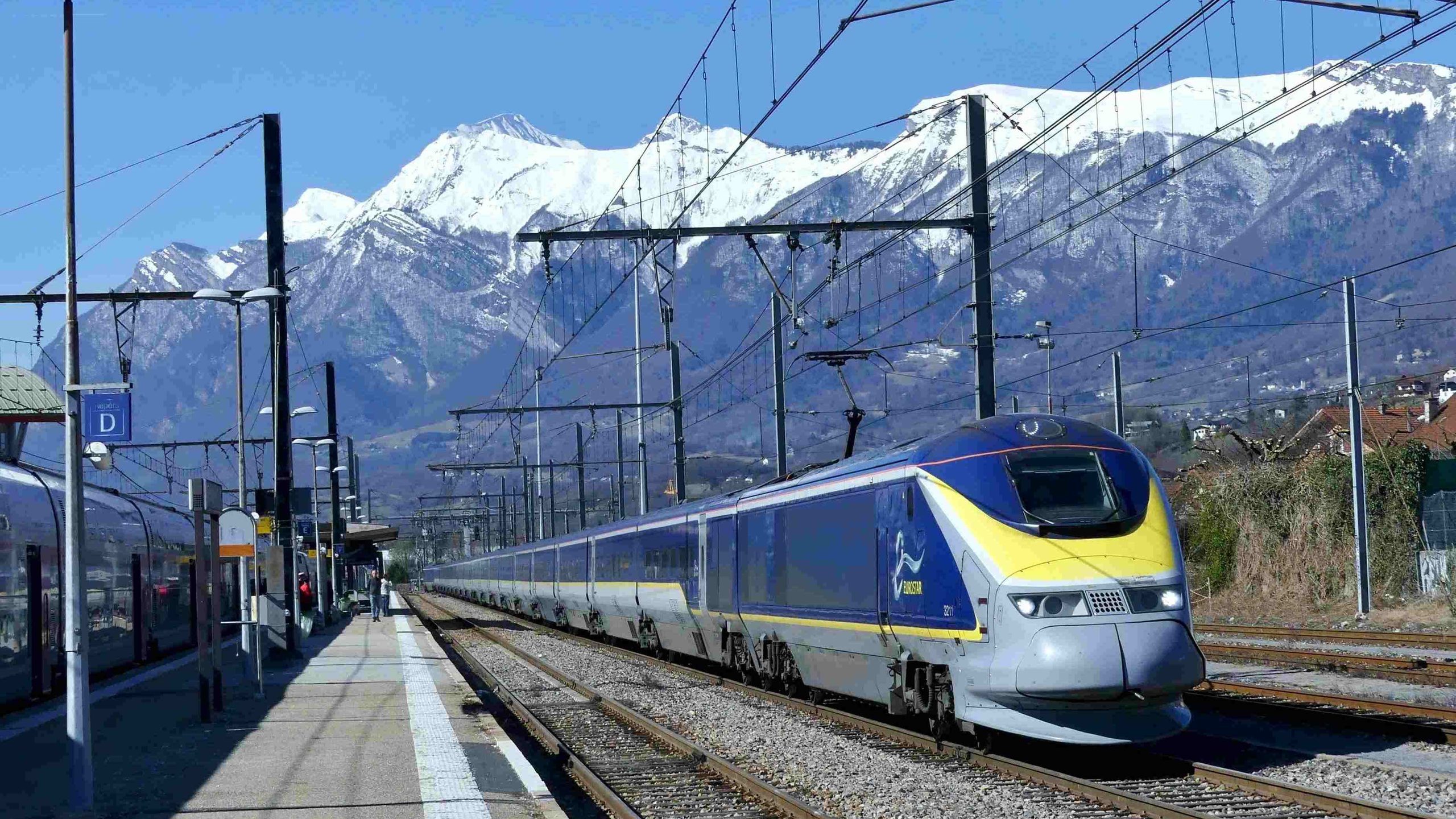
© Image by Florian Pépellin – Own work, CC BY-SA 4.0, Link
Words by Prof Stewart Barr, University of Exeter
Reducing the carbon impact of tourism travel is vital to meet the UK’s climate change commitments. Flying currently dominates short haul tourist travel to Europe but is very carbon intensive when compared to rail and coach travel. This blog post explores how governments and tour operators can promote no-fly travel for European holidays by focusing on positive meanings associated with no-fly holidays, the skills needed to use no-fly travel, and the infrastructure we need to support change.
In Europe, air travel has become a key part of the travel experience for many holidays (Barr and Shaw, 2022). Yet the majority of direct tourism emissions contributing to climate change come from flying to and from holiday destinations (Sun et al., 2024). Considerable media attention has focused on the potential of technological solutions to reduce these emissions, such as sustainable aviation fuels (SAF). Yet the UK’s Royal Society (2023) has questioned the feasibility of scaling-up SAF’s, with other scholars highlighting the significant resources required to roll out SAF’s at scale (Becken et al., 2023).
Instead, we argue that governments and tour operators should focus investment in promoting no-fly holiday travel to Europe by rail and coach travel, and shifting the emphasis of the journey away from speed towards new experiences. We use insights from our long-standing research in this field (Barr, 2018; Barr and Shaw, 2022) and a study undertaken with customers of three major UK tourist brands – Inghams Ski, Inghams Walking and Inntravel – to show how this can be achieved, and what governments, tour operators and individuals can do. These are summarised in a new toolkit: Travel Towards Net Zero: a toolkit for low carbon tourism travel.
The challenge: changing our holiday travel practices
In the absence of scaleable, short-term technological solutions to reduce emissions from aviation, we need to find ways to promote no-fly holidays that can take advantage of the existing sustainable travel options in Europe, and for which major investment will see further improvements between now and 2035 (European Commission, 2025).
But changing individual travel choices takes much more than designing information campaigns or raising awareness about climate change. We need to consider the wider context in which individual behaviours develop.
This means we need to change the conditions of the system in which we all make decisions and to identify the key role governments and the tourism industry have in leading change.
In other words, what can governments and the tourism industry do differently to help shift the conditions in which customers make their decisions, and show they are taking a lead?
Opportunities for the tourism industry
We argue that now is the right time for the UK Government and tour operators to focus on promoting no-fly travel because of the following factors:
- Public attitudes on climate change: 79% of people surveyed by DESNEZ in 2025 were ‘very’ or ‘fairly’ concerned about climate change (DESNEZ, 2025).
- A belief in collective action: 80% of people in the same DESNEZ survey felt that ‘if everyone does their bit, we can reduce the effects of climate change’ (DESNEZ, 2025).
- Improving infrastructure: The European Commission’s (2025) EU Plan for High-speed Rail and the introduction of competition in passenger services on the UK’s High Speed 1 line signal big improvements in travel times and increasing capacity for no-fly travel.
- Simplifying booking: The European Commission’s (2026) proposal to require major European rail operators to sell other operators’ tickets across national borders, to promote single-purchase tickets for multiple journey legs on a range of platforms, and associated simplification of delay compensation.
- Modal shift feasibility: These increases in capacity reinforce the existing feasibility of getting to much of western Europe easily with two or three changes, something which has regularly been demonstrated as feasibly within part of the industry (e.g. Byway, Green Traveller, Seat61 and Snowcarbon).
- Changing the holiday travel narrative: Travel can be so much more than getting from A to B. It can be part of the holiday experience, offering opportunities for stopovers, cultural visits and new adventures.
- Becoming market leaders: Tour operators have a golden opportunity to reflect their own and their customers’ concerns about climate change and offer them an attractive alternative to air travel.
Changing Our Holiday Travel Practices: a framework
If we want to see very substantial shifts in how customers travel for their holidays, then we need to change the way we think about tourist travel behaviour and recognise that rather than focusing just on individual customer choices, we need to concentrate on the way that our systems of provision promote shared social practices that millions of us have in common and which have become so embedded. These systems of provision are about the mix of marketing, booking processes, infrastructures and support that lead customers to make the choices they do.
Looked at from this perspective, we can start to ask questions about how we can change the dominant social practice of flying for holidays:
- How might holiday travel be done differently in a way that can be attractive and hold meaning?
- What investment is needed in sustainable transport infrastructure to support low carbon tourist travel?
- In what ways do tour operators need to support their customers and colleagues to travel and arrange holidays differently?
We can think of these questions as different elements of a social practice (Shove et al., 2012), all of which are required to create and sustain a practice:
- Meanings are the social desirability of how we travel for holidays and the value people gain, such as feelings of belonging, status, acceptance and affirmation.
- Materials are the infrastructures, technologies and physical things that support how we travel for holidays, from booking systems to terminal buildings and from propulsion technology to suitcases.
- Competences are the skills or know-how required to travel for holidays, from the process of booking to successfully using a particular transport mode.
A Toolkit For Low Carbon Tourism Travel
Working with customers and colleagues of Inghams Ski, Inghams Walking and Inntravel, we undertook eight online workshops in January and February 2026 with a total of 50 of their customers, to explore the issues customers faced when considering no-fly travel for European holidays. These brands provide a range of package holiday options for skiers and walkers to Alpine and other European destinations, many of which can be reached by no-fly travel.
The workshops focused on three topics, all of which were discussed using inter-active online tools:
- The worries and challenges of no-fly European holiday travel.
- The wants and need for a good no-fly European holiday experience.
- The actions that governments, tour operators and individuals can take.
It’s important to stress that customers were asked to consider their broad travel experiences in the workshops, rather than commenting on specific brands, and our findings reflect these wider holiday experiences.
Worries and Challenges, and Needs and Wants for no-fly holiday travel
The key concerns identified by customers in the workshops about opting to use no-fly travel for holidays were as follows:
- Journey breakdown: people worry they won’t get to where they are going on time.
- Cost and value for money: people worry about the cost of train services and getting value for money when compared to flying.
- Comfort and convenience: people worry about the quality of the no-fly travel experience.
And these were reflected in what participants needed and wanted from a positive no-fly experience:
- Traveller confidence: people need to feel confident they have access to reliable information and support.
- Getting a fair deal from no-fly travel: people need to feel confident they are getting a fair deal if they decide to go no-fly.
- Confidence in the journey experience: people need to feel confident that no-fly travel is comfortable and convenient.
Taking Action: government, industry and individual roles
The findings from the workshops highlighted the following headline actions that different stakeholders can take:
For the UK Government:
- Investing in the UK rail system. Participants highlighted how their negative views on rail travel were formed largely based on their experience of the UK rail system as unreliable and overcrowded, meaning that taking the train to start their holiday was off-putting.
- A fair tax on air travel. Reflecting the environmental impact of air travel in how flying and aviation fuel is taxed was seen as essential to ‘levelling the playing field’ between different transport options for holiday travel, which participants perceived as favouring the aviation industry
For UK tour operators:
- Lead and lobby government and industry for change. Collectively, the industry has the potential to lobby the UK Government to invest in rail travel, promote cross-channel train services, and implement a fair taxation system that reflects the environmental impacts of aviation.
- Make no-fly visible in marketing and booking. Tour operators can highlight, promote and market the options that already exist for no-fly holidays. Experimenting with ‘no-fly first’ approaches on websites and in brochures can help shift the default from flying to no-fly travel.
- Build confidence in no-fly travel from the start. Customers need to be confident when booking that they can easily use no-fly travel. Having resources for customers on websites and on the phone, such as customer vlogs, blogs, hints and tips, all instil confidence when booking.
- Promote the green travel experience. Demonstrating the carbon savings of no-fly travel can help promote no-fly travel. Importantly, using non -technical language and giving like-for-like comparisons between fly and no-fly options is key. For example, the cost of the whole journey should be used when comparing different travel modes, which for flying would include airport transfers, seat selection and hold baggage (usually omitted from headline airfares). Likewise, time comparisons between flying and no-fly options need to include the door-to-door travel time, not just the ‘time in the air’.
- Be there every step of the way for customers. Support from the moment of booking until arrival at the destination is needed for those customers who are unfamiliar and anxious about no-fly travel. This will vary between the holiday product offered but might include online chat functionality, a helpline, company reps at resort stations and detailed notes and supporting videos for travelling on certain routes.
- Do the heavy lifting for customers: luggage support. Luggage can be a major barrier for promoting no-fly travel, because items such as skis or large suitcases cannot be checked-in for no-fly travel, and so customers need to carry them themselves. Giving clear information about appropriate luggage sizes, storage areas on trains and walking distances at stations can all help in reducing anxieties. Indeed, considering luggage transport options from home to resort can also be helpful.
- Travelling better for holidays: broadening no-fly horizons. Travel can be more than getting from A to B. It can have much more meaning and be an exciting, revealing and sociable experience. Promoting the journey itself and the flexibility that no-fly travel offers to stop-off, have an extra city break or simply appreciate the changing landscape are all valuable marketing opportunities for tour operators.
For individuals:
- Influence family and social networks to promote no-fly travel. Although we want to emphasise what government and industry can do, participants in our research also highlighted how they can use their social networks and their no-fly travel experiences to promote change.
The message from our participants was clear, for many of the ideas they explored:
‘A lot of these issues can very easily be overcome, and you could get some fast wins to start with and if companies are committed to doing this, then that is exciting’
Message from participants
Reducing the impact of flying on the climate needs to be considered as a social, rather than technological challenge. In our toolkit, we’ve demonstrated how focusing on changing social practices – the meanings of holiday travel, the skills needed to use no-fly travel and the changes in systems to support such changes – are all vital to changing the narrative and re-imagining what a sustainable holiday looks like. The tourism industry has a great opportunity to promote the no-fly experience and to work with government to ensure the infrastructure exists to support this.
Download the Travel Towards Net Zero: a toolkit for low carbon tourism travel.
Follow us on Bluesky and LinkedIn and subscribe to our newsletter for future updates from the CAST team.